Explore the live productFree account · 1 hour of product exploration

    Discounted cash flow valuation from filings

    Build a DCF from reported free cash flow: forecast, discount at WACC, add terminal value and bridge enterprise value to value per share.

    How do you value a company with a discounted cash flow model?

    A DCF values a business as the present value of the free cash flow it will generate. You forecast unlevered free cash flow for an explicit period, discount each year at the weighted average cost of capital, add a discounted terminal value, then subtract net debt to reach equity value per share.

    What you see in Market Ontology

    The live product, read-only. Your own work opens here after checkout.
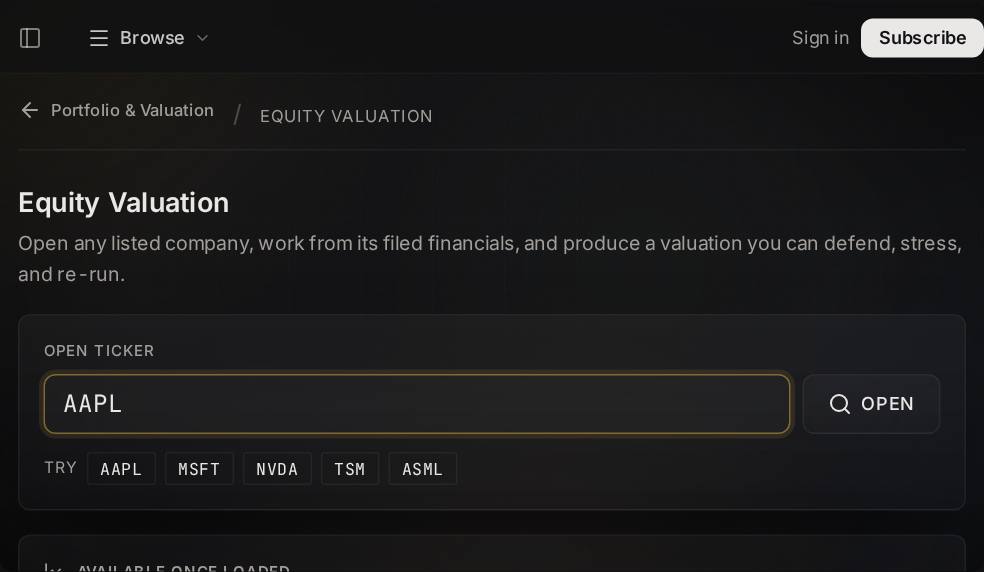
    DCF Valuation screen in Market Ontology
    Explore the live productFree account · 1 hour of product exploration

    Start the job

    DCF valuation preview

    The entered operating assumptions imply $43 of enterprise value in this structural preview.

    Calculated
    Enterprise value
    $43
    PV forecast
    $24
    PV terminal
    $18
    Terminal value share
    42.9%
    • — Forecasts are in millions; modeled cash flow equals forecast × (margin less reinvestment).
    • — Preview terminal growth is capped at 3%; cash, debt and share count are entered in the full model.
    • — This is a deterministic valuation, not investment advice.

    DCF formula engine

    Method

    • — Free cash flow to the firm = EBIT × (1 − tax rate) + D&A − capex − change in working capital, starting from reported filings.
    • — Discount rate = WACC, combining cost of equity (risk-free rate + beta × equity risk premium) and after-tax cost of debt.
    • — Terminal value by Gordon growth: FCF(n+1) ÷ (WACC − g), with g kept below long-run nominal growth.
    • — Equity value = enterprise value − net debt − minorities; divide by diluted shares.

    Limits

    A DCF is only as good as its inputs: terminal value often exceeds half of the result, so small changes in WACC or g move value materially. Treat it as a range, not a point.

    Updated 2026-10-15

    Questions

    What discount rate should a DCF use?
    WACC for unlevered free cash flow. Cost of equity alone is used only when discounting free cash flow to equity.
    Why does terminal value dominate a DCF?
    Cash flows beyond the forecast window are summarised in one number; for growing companies that perpetuity carries most of the present value.
    How is a DCF different from a reverse DCF?
    A DCF estimates value from your assumptions; a reverse DCF starts from today's price and solves for the growth the market already implies.