Explore the live productFree account · 1 hour of product exploration

    Reverse DCF: the growth the market already implies

    Solve a reverse DCF from today's share price: the free cash flow growth the market is pricing in, compared with the company's reported history.

    What growth rate is the current share price implying?

    A reverse DCF holds the discount rate and terminal assumptions fixed and solves for the free cash flow growth that makes the model's value equal the current enterprise value. If the implied growth exceeds what the business has delivered, the price embeds an optimistic case.

    What you see in Market Ontology

    The live product, read-only. Your own work opens here after checkout.
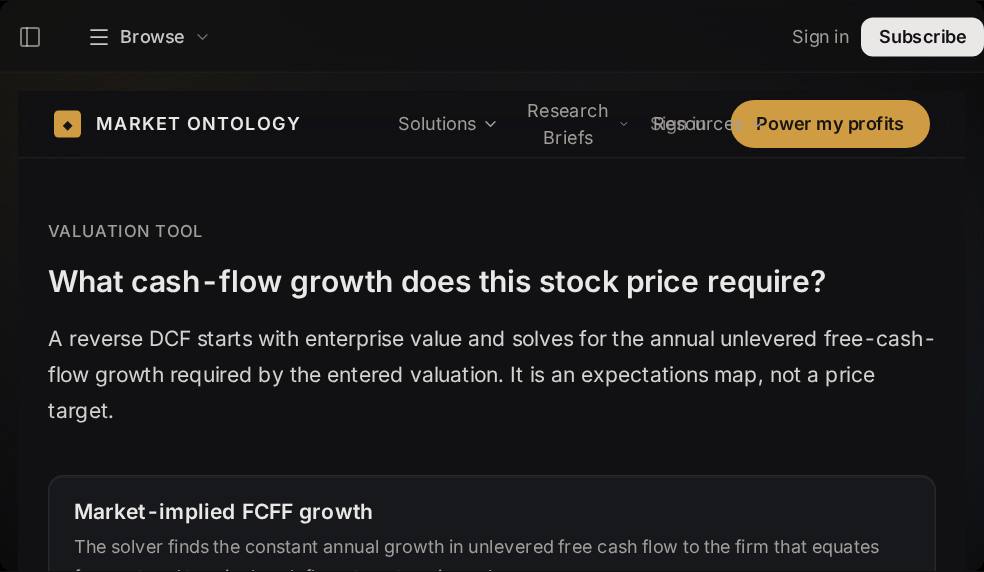
    Reverse DCF screen in Market Ontology
    Explore the live productFree account · 1 hour of product exploration

    Start the job

    What opens after checkout

    Implied growth, solver residual and saved expectations case, built from the details above and saved to your account in Market Ontology.

    You get
    Implied growth, solver residual and saved expectations case
    Opens in
    Market Ontology
    Built from
    Price, shares, cash flow, debt, margin, discount rate
    Orders
    None; nothing is sent on your behalf

    Method

    • — Enterprise value = market capitalisation + net debt from the latest filing.
    • — Fix WACC and terminal growth, then iterate the explicit-period growth rate until present value equals enterprise value.
    • — Compare implied growth with trailing revenue and FCF growth from reported statements.

    Limits

    The implied figure depends on the WACC and terminal growth you fix; it measures expectations, not fair value.

    Updated 2026-10-15

    Questions

    Why use a reverse DCF instead of a DCF?
    It avoids forecasting from scratch: you judge whether the expectations embedded in the price are plausible.
    What does a negative implied growth rate mean?
    The price can be justified even if cash flow shrinks — the market is pricing in decline or high risk.